
What Is Saju? A Beginner's Guide to Korean Fortune Telling
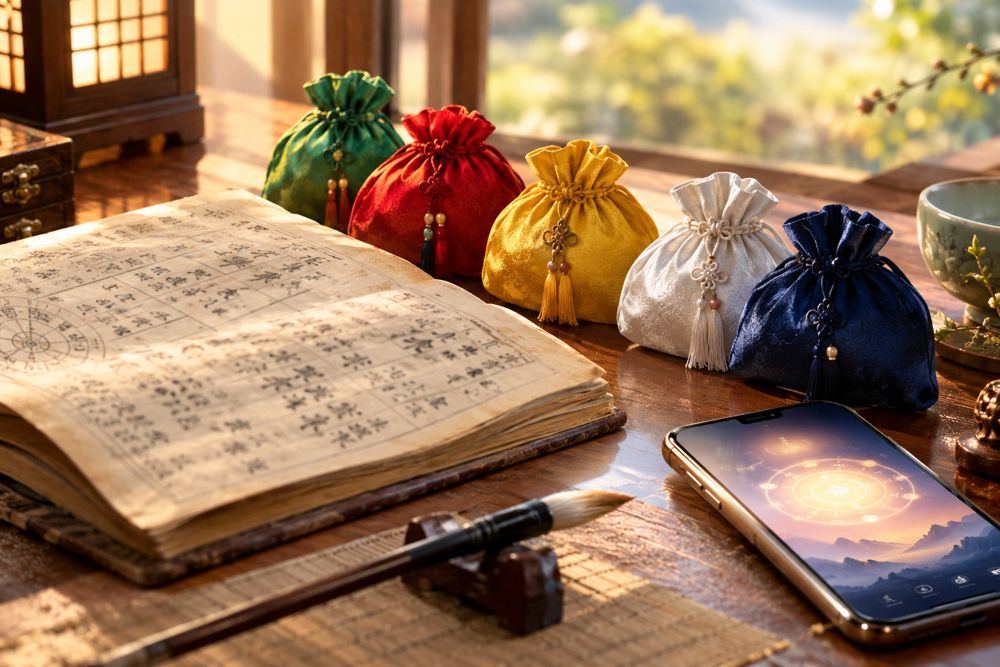
Ask a Korean friend about an important decision — a wedding date, a business launch, even a baby's name — and there is a good chance a Saju reading is involved. Saju (사주, 四柱) is Korea's traditional system of fortune telling, studied for centuries and still part of everyday life. This guide explains how it works, in plain language, and how Koreans actually use it today.
The Four Pillars: your birth moment, written down
"Saju" literally means Four Pillars. When you are born, that moment is recorded in the traditional calendar as four pairs of characters: the year pillar, the month pillar, the day pillar and the hour pillar. Eight characters in total — which is why a full reading is called Saju Palja (사주팔자), "Four Pillars, Eight Characters."
Each character belongs to one of the Five Elements — wood (목), fire (화), earth (토), metal (금) and water (수). So your chart is a small map of elements: some strong, some missing, some in tension. A reading interprets that balance — what you naturally lean on, and what you need more of.
The Day Master: the "you" of the chart
The most important character is the stem of your day pillar, called your Day Master (일간, 日干). It represents you. Everything else in the chart — and everything in the calendar that follows — is read in relation to it.
This is the key idea behind a daily fortune. Every day also has its own pillar (the day's 일진). Your daily fortune describes what happens when today's energy meets your Day Master: a supportive day, a productive day, a day to be careful. Same calendar, different fortune for every person — which is exactly why Koreans find Saju more personal than a zodiac reading, where everyone born in the same year shares one text.
How Koreans use Saju in daily life
- Daily fortune (오늘의 운세) — a morning check of the day's flow: overall luck, plus love, money, health and work, often with a lucky color or lucky time.
- Big decisions — weddings, contracts, interviews, moving house: picking a good day from the monthly flow, and avoiding a bad one.
- New Year fortune & Tojeong Bigyeol (토정비결) — a beloved annual tradition: a verse-based forecast for the year ahead, read every Lunar New Year season.
- Compatibility (궁합) — comparing two people's charts, classically before marriage, today often just for fun between couples.
Reading yours every morning: the Cheonunse app
Traditionally you would visit a fortune reader (or wrestle with the Manse-ryeok almanac yourself). Today most Koreans simply open an app. Cheonunse (천운세) is a free Android app built around exactly the method above:
- Enter your birth date (solar or lunar) and birth time once — the app builds your Saju chart.
- Every morning at 7 AM, a notification delivers today's fortune: an overall score out of 100, detailed love / money / health / career readings, your lucky color, lucky time window and lucky item.
- Weekly and monthly views — a 7-day graph and a monthly calendar — let you spot good days and careful days before they arrive.
- Plus zodiac fortune, New Year fortune, horoscope, Tojeong Bigyeol and five-elements analysis, all free.
Download Cheonunse free on Google Play
A last word of balance
Koreans themselves treat Saju the way the Cheonunse listing puts it: as reference content rooted in traditional Myeongnihak theory — a lens for the day, not a verdict on it. Enjoy the ritual, note the lucky color, and still bring your own judgment to the big decisions. That balance is precisely how the tradition has survived this long.
See everything Cheonunse can do — and tomorrow at 7 AM, your first personal fortune is waiting.