
How to Practice Drums Without a Drum Kit
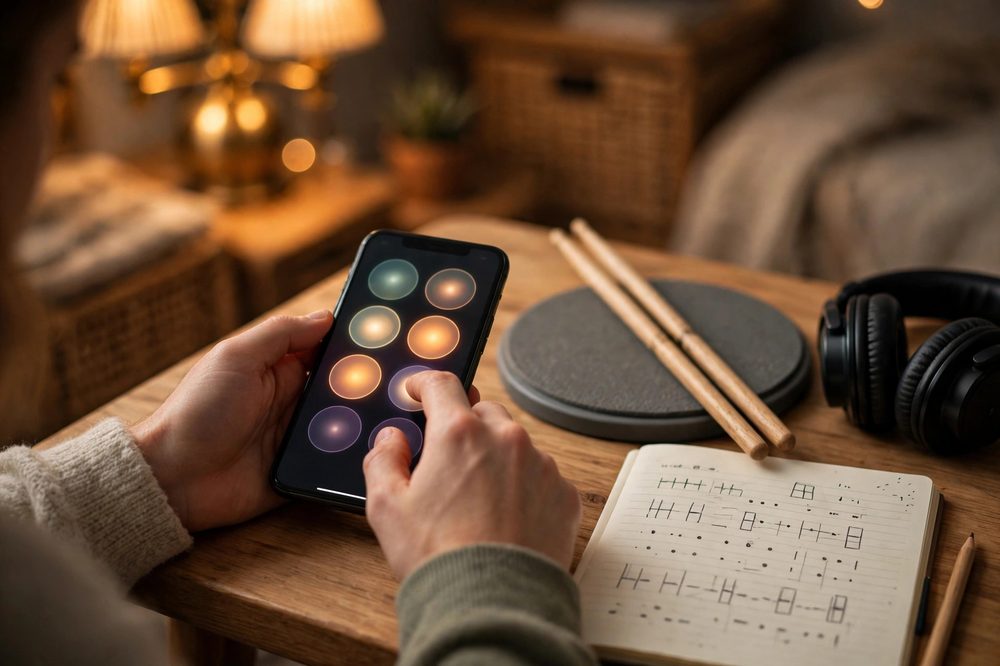
A real drum kit is expensive, takes a whole corner of a room, and makes enemies of everyone within three walls. So most people who want to learn drums simply… don't. But here is the honest secret: a large part of drumming is not the kit. It is timing, coordination, groove vocabulary and ear — and every one of those can be trained on a phone, quietly, with headphones, anywhere. Here is how to do it properly.
1. Timing: live with the metronome
Ask any drum teacher what separates beginners from drummers and they will say the same word: time. A metronome with adjustable BPM and different time signatures (4/4, 3/4, 6/8) teaches your body to subdivide a beat instead of chasing it. Start painfully slow — 60 BPM — and play one simple pattern until it feels boring. Boring is the feeling of the beat moving into your hands. Speed up only when slow feels easy.
2. Coordination: pads train your fingers like sticks
Finger drumming on velocity-sensitive MPC pads builds the same independence drummers need: kick pattern in one rhythm, snare answering in another, hats ticking steadily underneath. Multi-touch matters — you want all your fingers working at once, not one pointer finger doing everything. Alternate which fingers carry the "kick" and which carry the "snare" to keep both hands honest.
3. Groove vocabulary: jam with backing tracks
Playing alone teaches mechanics; playing with music teaches drumming. Backing tracks in rock, funk and trap force you to listen, leave space, and land fills where the music breathes. If the track's tempo is above your level, slow the backing down — playing a groove correctly at 80% speed beats flailing at 100%. Switch between drum kits (an acoustic rock kit and an 808 trap kit ask for completely different accents) to hear how the same pattern changes character.
4. Ear: learn what each drum actually does
Use a per-drum mixer — solo the kick, mute the toms, drop the snare — and you will quickly learn which drum carries the pulse, which one answers, and which one decorates. That ear is what lets real drummers hear a song once and know what to play.
A 15-minute daily routine
- Minutes 0–3 — Metronome groove. One pattern, slow BPM, aim for zero drift.
- Minutes 3–8 — Pad patterns. Two coordination exercises, alternating lead fingers.
- Minutes 8–13 — Backing track jam. Pick one track and one kit; play the whole song without stopping.
- Minutes 13–15 — Record & listen. Record the groove, name it with the date, and listen back critically. Next week, compare.
Recording is the step everyone skips and the one that teaches fastest: what you meant to play and what you actually played are two different recordings, and the gap between them is your practice plan.
What a phone can't teach you
Honesty time: a phone will not teach stick grip, wrist technique, or foot-pedal control, and when you eventually sit at a real kit there will be an adjustment period. What it builds — timing, coordination, groove sense, and the ear — transfers completely, and it is the part most self-taught drummers are missing. Think of it as learning the language before buying the instrument.
Start tonight
Our own Drums - Virtual Drum Studio was built for exactly this routine: 4 studio kits, MPC pads, a metronome with 4/4, 3/4 and 6/8, rock/funk/trap backing tracks with tempo control, a per-drum mixer, and a recorder with a library for your dated grooves. It is free on Google Play — and you can watch it in action on YouTube first. Fifteen quiet minutes a day, headphones on, neighbors none the wiser. 🥁
Download Drums free on Google Play See everything Drums does